
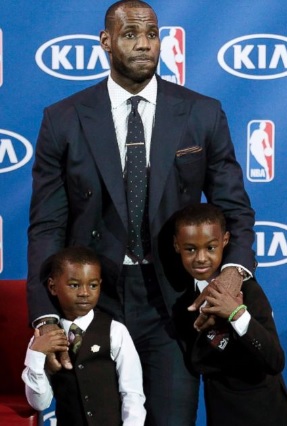
 At the end of February, NBA sensation LeBron James had a strong message for college recruiters: stop pursuing his son.
You see, LeBron Jr., age 10, is a top prospect among Division 1 ballers. In fact, according to the elder LeBron, junior has already received scholarship offers from some unnamed schools. “It’s pretty crazy,” LeBron Sr. said, adding, “It should be a violation. You shouldn’t be recruiting 10-year-old kids.”
I completely agree. Morever, I can relate to the kind of anxiety this attention probably causes LeBron Jr. I’ve been there. Sort of. Not really.
Let me start over. I’m tall. For many of you, that may come as quite the revelation. But it’s true. I’m like 6′ 1″ or perhaps a centimeter taller. I’ve always been tall. If memory serves, I was born like 41 inches long. You’re right, that can’t be. I think it was closer to 35 inches.
Whatever the case, it’s been a lifetime of height.
What is that like, you ask? I love it. I really do. For one, I’ve become very familiar with the missy’s section of every major department store over the years. Ask me where any item is located and I can rapid fire the answer. I don’t have to ask a clerk. I don’t have to wander around looking through racks, behind racks, under racks. I don’t need to look at a store directory. When you’ve been shopping in the same section since you’ve been like 5 years old, you learn where things are.
The other apparel related bonus to being tall is the fact that I’ve never had to wear hand-me-downs. Seriously. Never. I didn’t know anyone who was older than me that wore bigger sizes than I did, except for maybe my grandparents. Enough said.
Another advantage to being tall, your teen years are filled with rainbow and unicorn moments. Because while most teen girls are fighting with their moms about wearing high heels and makeup, tall girls are wearing flats and their moms are turning cartwheels. Tall girls never really think they need to be taller girls.
 As you grow up, the cool things associated with being tall continue to add up. When you’re tall, you can see everything and you can reach everything. You don’t have to purchase a stepladder, stepstool or step-anything. You’re not afraid of putting things on the top shelf of the pantry. You don’t stress about your feet not being able to touch the ground when you’re riding a bike or swinging. And you don’t fret about being tall enough to ride The Screamin’ Eagle. You know those, “You Have to Be This Tall Before You Can…” signs? I’ve been that tall forever. I’ve been able to ride The Screamin’ Eagle since I was like, 3.
I could go on and on about the benefits of being tall. But I won’t. Instead I’ll skip ahead to the best thing about being tall. Are you ready? The best thing about being tall has to do with the stories people make up about you. They assume you’ve done great things. They guess that you’ve played basketball or volleyball. They imagine you were once a superstar. They think that if you’re not the next LeBron James that you were LeBron James. Cool right?
True story: at least once a week, someone will ask me if I played sports in high school and/or college. It can be overwhelming because that’s a great compliment. They’re assuming I have some kind of athletic ability or something. At my son’s 6th grade basketball game last weekend, there was a sign on the wall of the gym that read, “No Slam Dunks.” A couple of people actually made certain that I saw the sign. (Full disclosure: If I could slam dunk a basketball, I probably wouldn’t be typing this blog right now. I’d be resting my right arm so I could sign my Nike shoe contract.)
The fact of the matter is I was never LeBron James. I feel bad when I have to admit that – especially to people who obviously had such high hopes for me. I would love to be able to tell the story about how I hit that last second buzzer beater, sending the semi-state game into overtime. But I would be lying.
 Here’s the truth. When I was a freshman in high school, I tried out for the girls’ basketball team. The night before the final cuts were to be made, my mom told me she had tickets for John Denver in the round. She told me that I was going to the concert. I would not be able to attend the final night of tryouts. At that moment, I saw my NBA life flash before my eyes.
And that brings me to the final benefit to being tall. When you’re tall and you experience disappointment, you don’t curl up in a ball and retreat – basically because it’s physically impossible for a tall person to curl up in a ball. Seriously, there’s no real hiding your feelings when you’re tall. That would be like hiding a billboard. And you can only lower your head so far before it becomes a pain in the neck. So instead, you stand even taller. You throw your shoulders back. You stand up straight.
You grow.
As crazy as it sounds, you quickly understand that this too shall pass and in the height of your maturity, you count your blessings.
You were tall. You’re still tall. You can reach the top shelf of the pantry. You can wear flats. And, you just saw John Denver in the round. There’s nothing Rocky Mountain higher than that.

 Life After Ted